
How to Search the Carter County Court Docket
The public route is an archive, not a database. Begin at the Carter County Circuit Court Clerk site. Pick either Circuit Criminal Dockets or General Session Dockets. Both indexes organize calendars by month. A month page then links to one or more dated PDFs, sometimes split by judge or calendar type. General Sessions month pages can separate regular, civil, and detainer dockets. Once the right PDF opens, use the browser or PDF find tool with an exact case number or visible caption. Some searches still take a page-by-page scan. Whenever you pull a line, note the court name, docket date, judge, PDF filename, and page number. That trail lets the clerk reproduce your search. It also keeps an old setting from being mistaken for the current one. The method is narrow. Yet it fits the public Carter County court docket that officials actually publish.
- Identify the court family and the likely month of the hearing or filing.
- Open the matching official month index, then select the date and judge when listed.
- Search the PDF for a case number or exact visible text and check nearby dates.
- Save the court, date, filename, and page with the docket notation.
- Contact the responsible clerk for a later setting, filed order, or certified copy.
A missing PDF line is not proof. The gap may reflect a different date, court, clerk, posting delay, or access rule rather than a case that does not exist.
Carter Court Docket PDF Archive
Carter County publishes its dockets, but the public path is split. The Circuit Criminal index sorts calendars by month. It can break dates out by the assigned judge. General Sessions keeps its own month structure. Regular, civil, and detainer links are housed under that same month structure. These are dated calendar publications. They allow no single cross-court query by name, charge, or case number. Nor do they prove that every Carter County court record is online. The Tennessee Courts public resources page presents the official statewide view that follows.
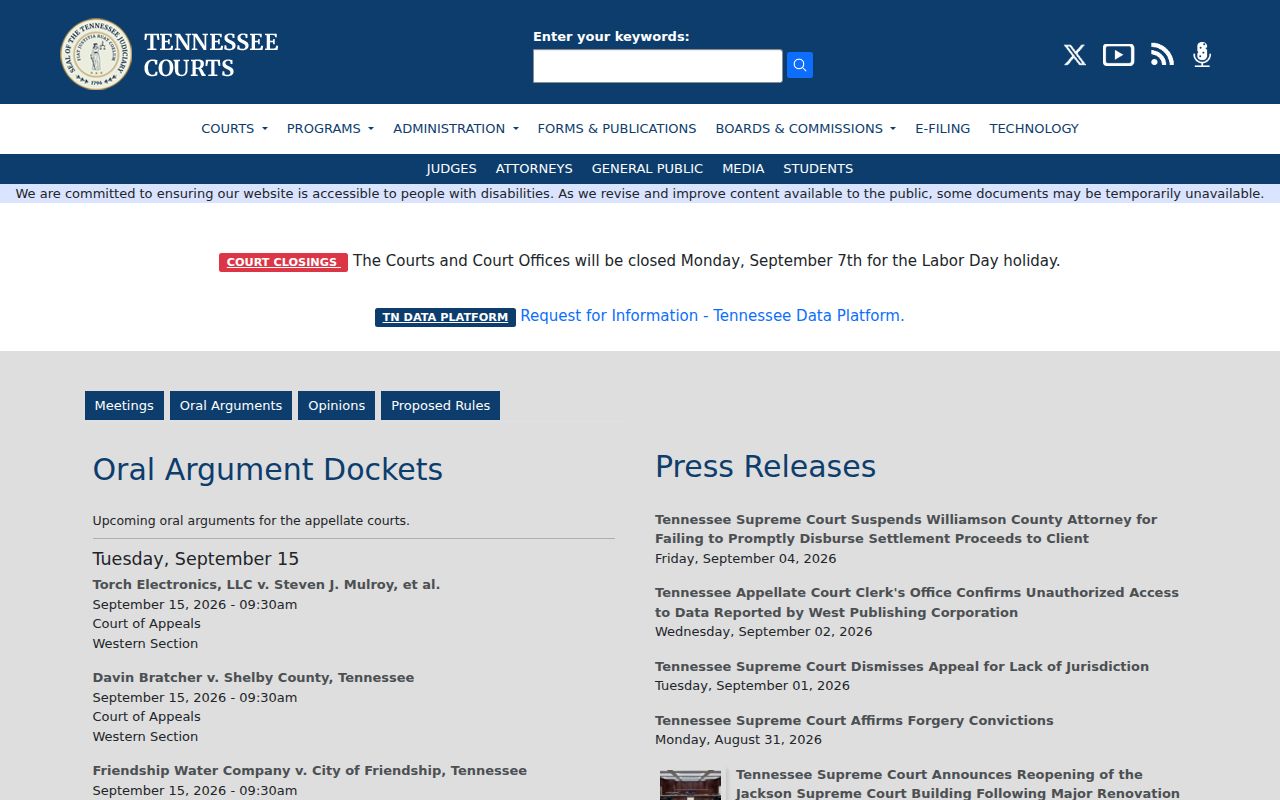
A statewide view helps you pick the right judicial layer, while the dated Carter County PDF remains the local source for the county setting printed on it.
One caution about the clerk site. The link labeled WebCaseSearch is not the public archive. It opens an Icon Case Management login that demands a user ID, password, captcha, and an official-use acknowledgment. Access attempts are logged, and unauthorized entry is prohibited. Public users should not treat the login as a hidden name search or try to get around it. When the PDF archive falls short, the sound fallback is the clerk by phone, counter, mail, verified email, or fax acceptance confirmed in advance. That route always works.
What a Court Docket Shows
A docket is a calendar or chronological record of court activity. Carter County samples vary by court. Still, their fields give a useful reading map. General Sessions criminal entries can show an index, event date, case number, State of Tennessee caption, charge, arresting officer, bondsman, attorney, and balance. A note may cover outcome or the next step. Circuit Criminal lines can add a plea deadline, bond amount, jail or hold notation, capias entry. A future setting may appear too. Civil lines use different fields. Expect the parties, a civil-warrant label, the amount, costs, and the result or next date.
| Court and Date | The court family and calendar date covered by that PDF |
|---|---|
| Case Number | The local identifier, which may use a numeric form or a prefix such as CV, ST, or TR |
| Caption | The named sides in the matter, not a finding about the merits |
| Charge or Claim | The matter placed before the court, not proof of a final result |
| Setting | A scheduled event that may later be reset or continued |
| Result or Note | Brief docket language that may require the filed order for full meaning |
Treat a docket line as a locator. It is not the whole file. The notation may omit the complaint, warrant, motion, exhibit, signed order, judgment, transcript, or official recording, so pull the underlying paper before you rely on it.
Reading Carter Court Docket Codes
Carter County court docket numbers lean on short codes that save space but can hide nuance. CV shows up in General Sessions civil numbers. ST marks state criminal or traffic examples, and TR marks a traffic example. Those patterns help you find a line. They do not set jurisdiction by themselves. A number from a municipal citation may fail in a county PDF.
- Setting
- A scheduled court event. It may be a hearing, trial, plea deadline, motion, or administrative appearance.
- VOP
- Violation-of-probation shorthand. The exact procedural status still requires the full docket context.
- Capias
- A court-process or warrant notation. Current enforceability must be checked with the clerk or official file.
- W/LIC and W/SCHOOL
- Local traffic notations tied to license or school-related conditions. Ask the court about their exact effect.
- Balance
- An amount shown with an entry. It is not automatically a current payoff quote.
- Agreed Order
- A civil order based on agreement. The signed document contains the terms that control.
Quote the code exactly when you ask for help. Include the docket date and page instead of guessing at an expansion. Take “Dismissed, may be expunged” as an example. That wording does not establish that an expungement occurred. A bond field shows no guilt, and a future date alone tells you nothing about the type of hearing.
Which Courts Keep Dockets
Carter County sits in Tennessee’s First Judicial District alongside Johnson, Unicoi, and Washington Counties. The trial courts share that regional structure. Their dockets and clerks stay distinct. Circuit Court holds broad civil jurisdiction and hears lower-court appeals. Criminal Court handles felony and other criminal jurisdiction assigned by law. Chancery Court covers equitable, domestic, probate, and related matters under Tennessee law and local organization. General Sessions hears limited civil and criminal matters. It also runs preliminary proceedings. Juvenile Court and municipal courts use separate routes. The Tennessee courthouse finder shows where each court sits.
The finder groups Circuit, Criminal, and Chancery courts at the courthouse. That helps with routing. It does not replace the clerk’s separate docket indexes.
| Court Layer | Docket Covers | Where to Start |
|---|---|---|
| Circuit Criminal | Felony and assigned criminal settings | Circuit Court Clerk month and judge PDFs |
| General Sessions | Limited criminal, traffic, civil, and preliminary matters | General Sessions monthly index |
| Chancery | Equitable, probate, domestic, and related cases | Clerk and Master |
| Municipal | City ordinance and many traffic matters | Elizabethton, Johnson City, or Watauga clerk |
| State Appeal | Civil or criminal appellate history | Tennessee Public Case History |
| Federal | Federal district cases tied to this area | PACER and the Eastern District of Tennessee |
Carter Docket Routes in District One
The First Judicial District directory connects a Carter County court docket to the right official. Carter shares judges and district resources with nearby counties. So one judge profile may name several counties. For identification, use the docket caption, court, and location. A judge's regional service list alone is a weaker guide for this. The district schedule also describes circuit and law court terms. It notes that four-month schedules exist. They are maintained in the Circuit Court Clerk and Clerk and Master offices. The First Judicial District directory is the official page behind that view.
When a public PDF is missing, the district listing still earns its keep. It points to official court and clerk routes. It does not ask a regional page to do trial-case work. Jurisdiction comes first. Confirm the latest setting after that.
Municipal, General Sessions, appellate, and federal calendars each run on their own systems. In the trial courts, jury matters get set at docket soundings. Clerks may preset nonjury matters. A docket sounding is a scheduling event, not a trial date. Treat it as tentative until the case itself confirms otherwise.
Note: A regional judge listing never moves a Carter case. It also cannot prove where its current hearing will occur, or move the case into another county.
Finding Court Dates and Settings
No single Carter County calendar covers every courthouse, judge, and case type. Pick the matching Circuit Criminal or General Sessions month page. Then open the dated docket. General Sessions may split regular, civil, and detainer schedules into separate links. A Circuit Criminal date can be divided by judge. For a city citation, read the court and date printed on it. Then follow that city's own route. Appeals and federal cases sit in separate docket systems.
Label what you find. It could be a docket sounding, motion, arraignment, plea deadline, civil docket, detainer calendar, trial, or something else. Each label marks a different stage. A future date in an old PDF may have changed later. The monthly landing page can also miss a continuance. The Carter County court calendar routes help sort these channels apart. The clerk should confirm dates tied to travel. The same goes for an appearance or a near deadline.
Date check: Confirm the court, judge, setting type, time, location, and most recent reset with the responsible clerk before relying on a saved PDF.
Carter General Sessions Docket Details
General Sessions is not one single list. The Carter County clerk's archive can place regular matters beside separate civil and detainer dates. A June 2026 index, for instance, showed recurring civil calendars plus selected detainer dates. So pick the calendar type along with the month. A result in the wrong list can look like no result at all.
Criminal and traffic-adjacent samples show charge, officer, bond, lawyer, balance, cost, license, school, dismissal, notice, and future-date notations. Civil examples carry CV numbers and may show a civil warrant, an amount, costs, an agreed result, a default, a trial, a consent judgment, or a motion for installment payments. These fields point toward the clerk-held file. They do not reproduce proof of service, a signed judgment, payment history, exhibits, or the full terms of an order.
When a General Session line resists you, give the clerk the calendar family, the approximate hearing date, the case-number prefix, and the exact item wanted. Need the date? Ask for a docket entry. Need the substance? Ask for the warrant, judgment, order, or payment document. That distinction keeps the request narrow and hands the office a clear target.
Public Access to Dockets
Tennessee law starts from public access to public court records. But access is judged record by record, field by field. A public docket entry can sit beside a sealed pleading or a redacted identifier. It can also sit beside a protected address, a confidential exhibit, a juvenile file, or an internal case-management record. And a missing online line proves nothing about sealing. It may belong to another clerk or another date. It may be an unposted docket. Or it may be a system with no public web access at all.
Carter County access framework:
Tennessee Supreme Court Rule 34 defines court records and recognizes both public access and protected categories.
Tennessee Public Records Act guidance explains prompt access and the general response path when a record is not promptly available.
Tennessee Supreme Court Rule 26 governs official electronic court recordings when that method is used.
Appellate Rule 24 describes the broader papers, exhibits, and transcript material that can form the record on appeal.
Inspection is generally free under state public-record guidance. Copies, certification, redaction labor, media, postage, or court services may carry charges. State guidance spells out common copy and labor terms. But Carter County posts no complete court fee sheet online. Ask the responsible clerk for an estimate, accepted payment, and whether certification or a seal is included.
Carter Court Docket Workload Context
Administrative statistics describe court workload, not the facts of one case. Tennessee's FY2024 report lists 1,207 Carter criminal counts filed and 1,103 counts disposed in District 1. Those are count-level measures. One case can hold several counts. So they are not totals of unique people and cannot predict an outcome. The large filing categories included probation violations, burglary and theft, other property, drugs, and offenses against public administration. For an individual result, the docket and filed order remain the proper source.
The Tennessee Judge Stats filters supplied the Carter County court record image below.
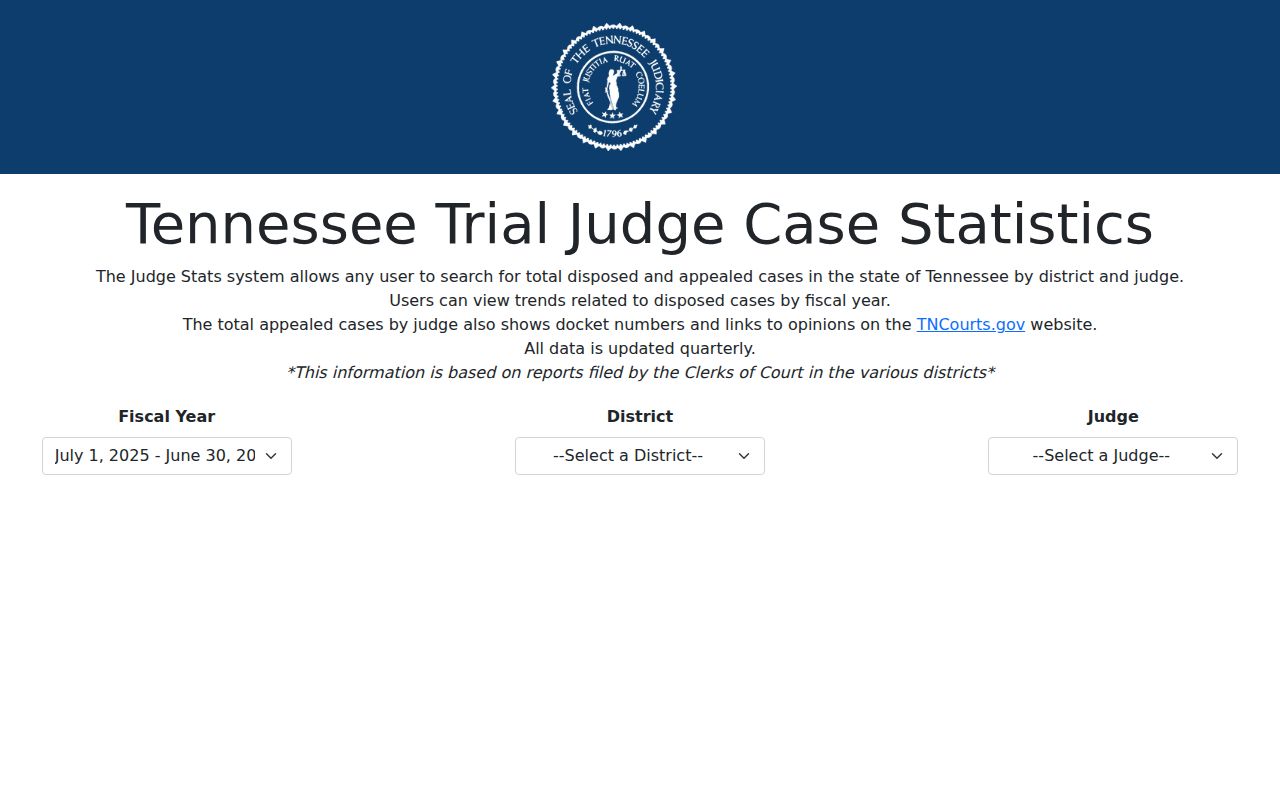
Judge Stats filters by fiscal year, district, and judge. It returns no parties, documents, case numbers, or hearing dates, so it supports aggregate research only.
The Clerk and Docket Records
Johnny Blankenship, Carter County Circuit Court Clerk, is the main contact for the Circuit Criminal and General Sessions calendars his office posts. The clerk site lists the courthouse annex. It sits at 900 East Elk Avenue, Suite 906, Elizabethton, Tennessee 37643. Phone is 423-542-1835 and fax is 423-542-3742. The state courthouse finder separately groups Circuit, Criminal, and Chancery courts at 801 East Elk Avenue. Keep both addresses handy. Call first to learn which counter holds the docket or file you need and to confirm current hours.
Carter County Circuit Court Clerk
Johnny Blankenship
900 East Elk Avenue, Suite 906
Elizabethton, TN 37643
423-542-1835
Fax: 423-542-3742
Chancery work runs through a different office. Andrew J. LaPorte serves as Clerk and Master at the 801 East Elk Avenue courthouse, reachable at 423-542-1812. Mary Gouge is the elected Carter County Clerk. It's an administrative job distinct from the clerks who keep court case records. Don't confuse the two. A citation from a city court goes to that city's own clerk.
Any request works best when it spells things out. Name Carter County, the court type, the case number if you have it, the docket or hearing date, and the exact item you want. Say whether you seek inspection, an ordinary copy, a certified copy, an order, an exhibit, or a transcript. Ask the office first whether email, fax, or mail is accepted. Leave out sensitive identifiers the office never asked for.
Carter Court Docket Judge Labels
Judge labels can sharpen a Carter County court docket search. Keith Bowers Jr. appears in official district material. He is identified with Carter County General Sessions Court. Stacy L. Street and Lisa Nidiffer Rice sit as First District Criminal Court judges. Both serve in the regional structure. A Carter month page can sort one date by judge. Suzanne Sweet-Cook is listed as a First District Circuit Court judge. These public roles help you match an index link to a PDF. But the docket heading and its date still carry the most weight. The official Tennessee judges listing shows the state's own record of these assignments.
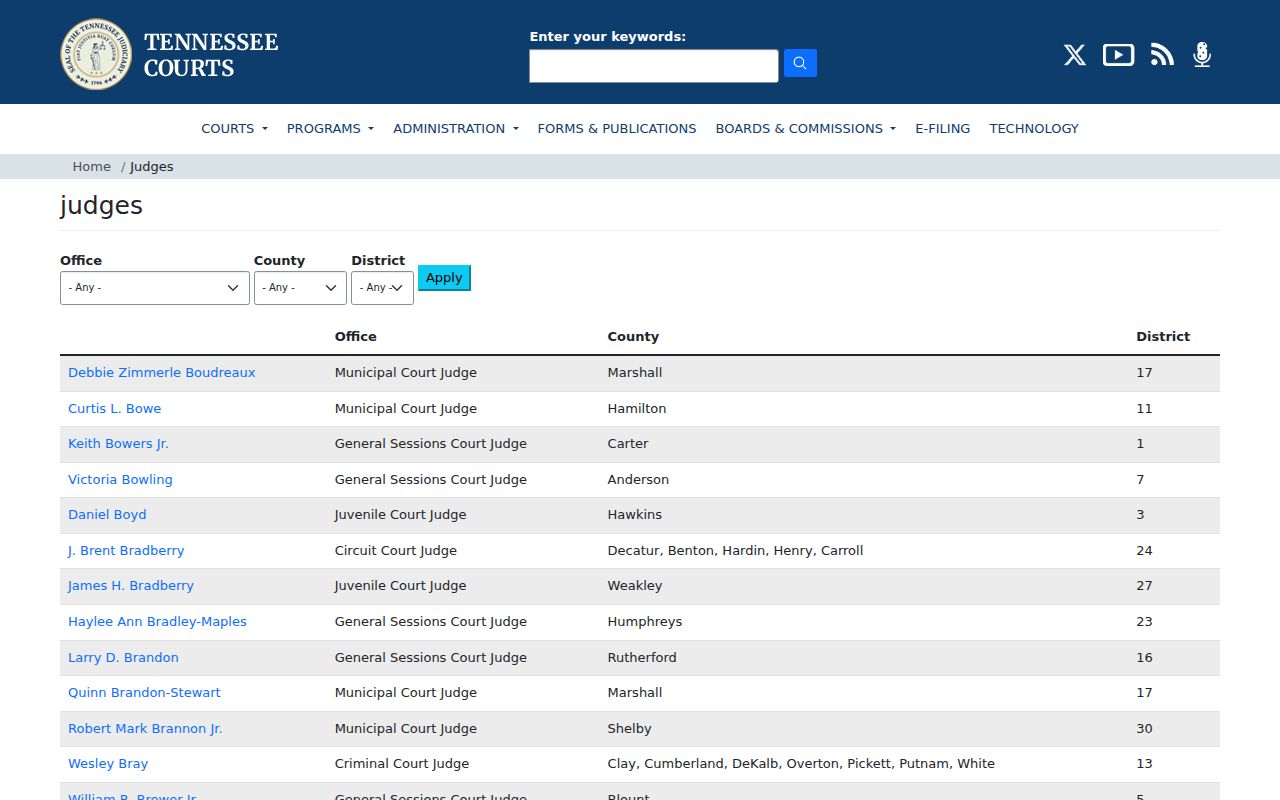
The state listing confirms who a judge is. The local PDF tells you whether that judge sits in the particular Carter County setting you care about. A name alone won't get you there. District judges can serve several counties. An old PDF may reflect a prior assignment rather than the current one. Pair the name with Carter County, the court family, the month, the date, and the case number. If anything conflicts, the clerk can tell you which setting is current.
Carter Court Record Copy Requests
The posted docket tells you when a matter was set and what short note landed on the calendar. Anything deeper needs the file. Pleadings state claims and responses. Orders and judgments hold the court's operative terms. Exhibits stay with the case materials under access rules. An electronic recording, where one exists, is not the same as a transcript prepared through an authorized process. On appeal, the record can include certified trial papers, original exhibits, and transcript or statement material.
Request the narrowest item that answers your question. Give the court, case number, date range, record type, preferred format, and whether certification is required. When a clerk cannot produce a record right away, Tennessee public-record guidance generally calls for production, denial, or a lawful explanation of the delay within seven business days. Court-specific rules, sealing orders, and statutes still control.
| Need | Request | Verify |
|---|---|---|
| Review only | Inspection of the named public item | Counter, format, and access limits |
| Working copy | Ordinary paper or electronic copy | Page, labor, media, and delivery charges |
| Official proof | Certified copy with any required seal | Certification fee and accepted payment |
| Spoken record | Recording or transcript, as appropriate | Court reporter, transcriber, format, and cost |
Carter County posts no court-specific fee sheet or local request form. Don't treat a statewide amount as the full local price, either. The Carter County court records process separates the docket locator from the filed document and the clerk's current quote.
Carter County Municipal Court Dockets
Municipal court records travel on city channels. They don't merge into Carter County Circuit Criminal or General Sessions PDFs. Living in the county makes no difference. Tennessee municipal courts usually handle ordinance and traffic matters within their own jurisdiction. Elizabethton offers a public municipal citation portal. Johnson City runs its own city court and records routes. Its city limits cross county lines. Watauga has a separate municipal clerk contact but no working public docket portal.
Elizabethton's official Tyler portal lets you search by citation number with a date of birth. It also accepts driver-license details, plate details, a name with a date of birth, or a business name. It warns that citations before 2007 may not be online. Stick to the official secure form and to identifiers tied to your own citation. Never email or post a Social Security number, birth date, or license value. For Johnson City and Watauga, no public search may apply. Start then with the current city clerk listing.
Jurisdiction matters more than home address. A county General Sessions traffic line, an Elizabethton citation, a Tennessee appeal, and a federal case can all touch one person. That person is connected to Carter County. Each sits in a different system. Read the issuing court printed on the citation or notice before you search.
Court Dockets by City in Carter County
Three incorporated cities tie into Carter County's municipal court research. Elizabethton, the county seat, keeps a public citation-search route. Johnson City overlaps Carter and neighboring counties. Its municipal record path turns on city jurisdiction rather than a Carter-only population or archive. Watauga is incorporated across Carter and Washington Counties. It relies on direct city contact, since no public Watauga docket search exists.
Elizabethton Court Docket
Search the county seat’s municipal citation route and distinguish city records from Carter County trial dockets.
Johnson City Court Docket
Use the municipal court channel for city ordinance and traffic matters, including the part of Johnson City that overlaps Carter County.
Watauga Court Docket
Start with the verified municipal clerk contact for Watauga citations, settings, payment questions, and record inspection.
Hampton and Roan Mountain are recognized localities. The Tennessee municipalities list does not show them as incorporated cities. Neither place gets a separate municipal docket or city page here.
Map and Directions to the Carter County Circuit Court Clerk Annex
Circuit Criminal and General Sessions dockets are kept by Circuit Court Clerk Johnny Blankenship at the courthouse annex, 900 East Elk Avenue, Suite 906, in Elizabethton. Chancery files are kept separately with the Clerk and Master at the main courthouse building a short distance away at 801 East Elk Avenue, where the state's courthouse finder groups Circuit, Criminal, and Chancery Courts. Call ahead to confirm which of the two Elk Avenue addresses holds the record being requested.
Carter County Circuit Court Clerk
Johnny Blankenship
900 East Elk Avenue, Suite 906
Elizabethton, TN 37643
423-542-1835
Fax: 423-542-3742
Carter County Clerk and Master
Andrew J. LaPorte
801 East Elk Avenue
Elizabethton, TN 37643
423-542-1812
No official source confirms current public-terminal availability, parking, or security-screening rules at either building, so plan to call the clerk before traveling for a specific docket or file.