
The Carter County Court Calendar
The clerk publishes separate Circuit Criminal and General Sessions month indexes. Circuit pages lead to dated, sometimes judge-labeled PDFs. Sessions pages can separate regular, civil, and detainer calendars. Readers must choose the docket family before the day.
These are operational calendars, not one live database. Later action can supersede a PDF. Record the court, judge, date, filename, and page when confirming a result.
Regular, Civil, and Detainer Calendars
The June 2026 General Sessions index demonstrates the split: regular dates appear beside Civil links for June 4, 11, 18, and 25 and Detainers links for June 4 and 25. Looking only at the regular list can miss a matter on the same day. Capture the label with the date.
Circuit Criminal follows another month, date, and judge route. A landing page shows posted PDFs but cannot guarantee that every later continuance or cancellation appears in a saved file.
How to Find Your Court Date
Start with the court named on the notice, citation, filing, or prior entry. Carter uses month-and-PDF searching, not a public party-name database. Use an exact case number where possible. If the line is missing, give the clerk the family, approximate date, judge, and number fragment.
- Identify Circuit Criminal, Sessions regular, civil, detainer, Chancery, municipal, appellate, or federal court.
- Open its month index and choose the dated PDF and judge where listed.
- Search the exact case number or visible caption and read the latest setting.
- Confirm it with the clerk, courthouse posting, or attorney before appearing.
Four-Month Circuit Docket Schedule
The First Judicial District schedule says Carter terms begin on the first Monday of March, July, and November and end in April, August, and December. Jury cases are set at docket soundings every four months; nonjury matters are preset by clerks. This planning layer is not an individual hearing notice.
A docket sounding can organize trial work without being the trial. Compare it with the newest case-specific notice and clerk entry. A later order or continuance controls the practical date.
How to Cite a Calendar Result
A reproducible calendar note should identify the official Carter clerk source, the docket family, month page, linked PDF filename, calendar date, judge if named, page number, and the date the source was checked. This detail matters because the same month can carry regular, civil, detainer, and multiple judge-specific files. It also lets the clerk locate the item if a link later changes.
Quote only the minimum relevant notation. Do not republish birth dates, addresses, license values, financial information, or other identifiers that happen to appear in a public record. A citation documents what the dated calendar displayed; it does not certify that the event remains current or that the docket is the complete case record.
Reading a Court Setting
The PDF heading identifies court and date; the index may identify a judge. A line can carry a next date, plea deadline, trial label, motion, civil result, or shorthand. A future date is not a disposition, and an old file is not necessarily the current schedule.
| Date | The date in the heading or next-setting field. |
|---|---|
| Time | A stated time or docket-call context requiring confirmation. |
| Court | Circuit Criminal, Sessions, civil, or detainer family. |
| Judge | The judge named by the index or PDF, when supplied. |
| Setting Type | Plea deadline, motion, sounding, trial, detainer, or another event. |
Confirm the Carter Clerk Route
The Tennessee clerk directory distinguishes court offices.
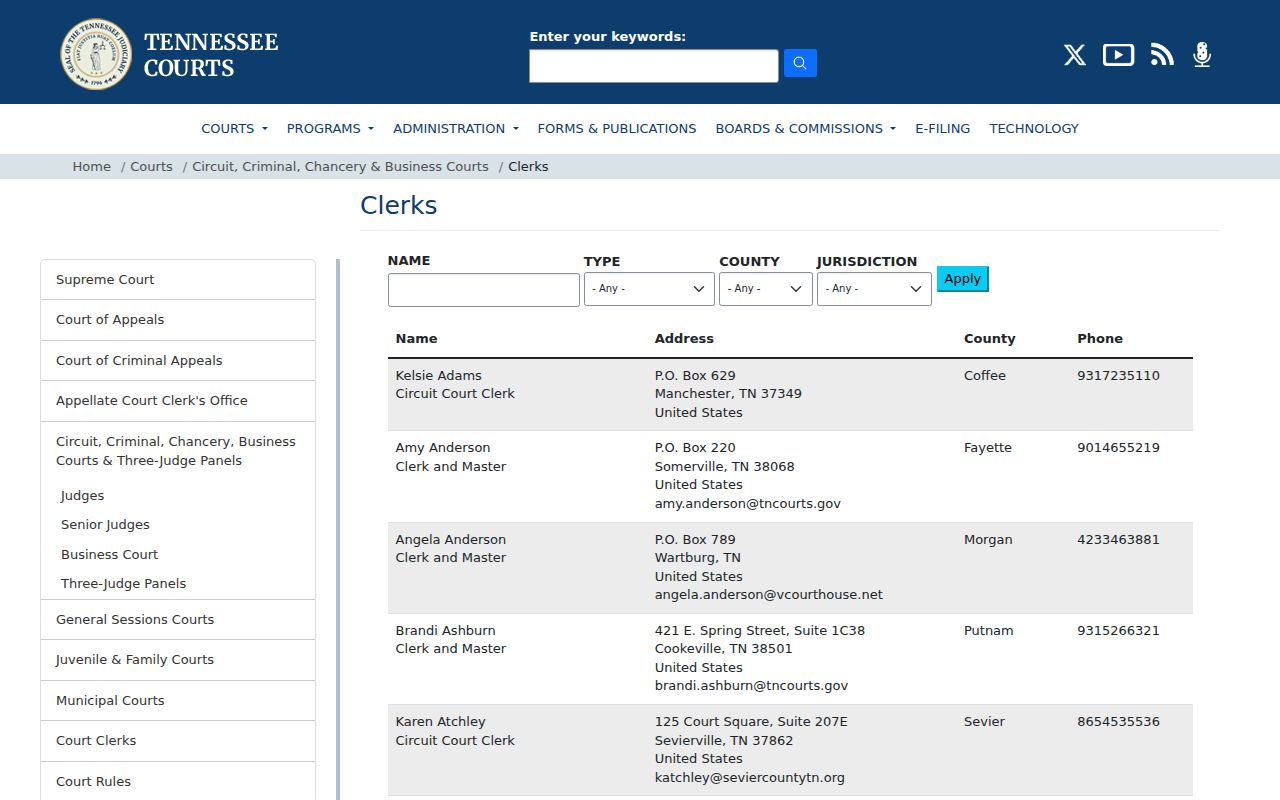
The image supports a key rule: identify the court before contacting an office. Circuit Criminal and Sessions route through Johnny Blankenship; Chancery routes through Andrew J. LaPorte. Courts are grouped at 801 East Elk Avenue, while the Circuit Clerk lists its annex at 900 East Elk Avenue, Suite 906. Call to confirm the counter and hours.
Resets, Continuances, and Cancellations
A continuance moves a matter; a reset changes a date or event; a cancellation removes a scheduled item. A month page or saved PDF can lag behind later courtroom action. Missing from a later list does not itself mean dismissal.
Check the newest source, ask whether another PDF or order supersedes it, and consult counsel when represented. Verify on the business day before travel because no complete Carter cancellation and holiday feed was located.
No Single Countywide Calendar
Elizabethton citations use the city portal or the date printed on the citation. Johnson City and Watauga route to city clerks. Public Case History is appellate-only, and federal cases use PACER and the Eastern District. Residence does not place every matter in Carter PDFs.
Chancery also lacks a public Carter keyword calendar in the inspected sources. Identify whether the originating paper names a city, Clerk and Master, appellate court, or federal court. Jurisdiction is more useful than residence.
Verify Before Traveling to Elizabethton
The safest sequence is to open the newest official month page, record the relevant PDF and line, check any later entry, and call the responsible office on the business day before travel. Ask whether the date is a docket sounding, plea deadline, arraignment, motion, trial, civil docket, detainer calendar, or administrative event. Those labels can describe very different obligations.
The courthouse and annex addresses should not be collapsed into one generic destination. Confirm whether the appearance itself and the clerk counter are in the same building. The research did not locate a single authoritative local source for all current hours, room assignments, closures, holidays, or remote appearances. A fresh clerk confirmation is therefore more dependable than directions copied from an older PDF.
Carter Setting Language in Context
Local PDFs use short operational terms. Regular distinguishes a general Sessions calendar from civil or detainer lists. A setting is a scheduled event, while a future date can be a reset rather than final disposition. Plea deadline identifies a deadline in the criminal calendar context. W/ATTY can indicate attorney involvement, and W/COSTS refers to costs in the docket line. These notations should be quoted rather than freely expanded.
Capias, VOP, bond, hold, balance, dismissal, and school or license notations also require file-level context. A calendar entry does not by itself prove a current warrant, guilt, payment balance, licensing consequence, or completed expungement. For an explanation that affects what a party must do, use the clerk-held record and legal counsel rather than an isolated abbreviation.
What to Do If You Miss a Setting
Contact the responsible clerk and any attorney immediately. Ask what the docket records, whether another setting exists, and what formal action is required. Do not rely on an old PDF or appear without confirming the office and status.
Missed a Setting? A missed criminal date can lead to failure-to-appear, capias or warrant, or bond consequences depending on court action.
Contact the clerk and attorney immediately for the recorded status and proper next step.
Consult a licensed Tennessee attorney about a missed Carter County setting before appearing.
Calendar Dates Need Currentness Labels
A Carter calendar reference should say when the source was checked and the date printed on the PDF. The clerk's 2026 pages establish an active publication practice, but they do not establish that every case or later change is online. Labeling the source “posted docket checked on” a date prevents an archived setting from being presented as live.
State modernization announced in 2025 describes work toward broader case-management and e-filing capability. It should not be described as an already available unified Carter public portal. Until an official public endpoint exists, the documented route remains the county month indexes, date-specific PDFs, clerk contact, and separate city, appellate, or federal channels.